
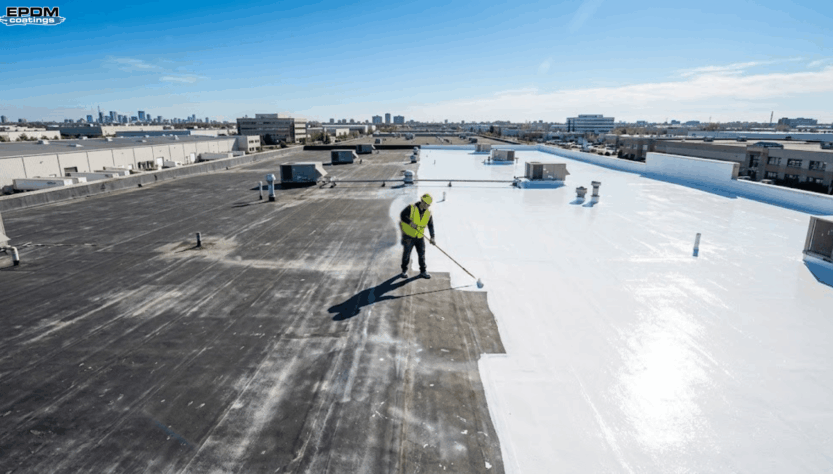
Let’s be completely honest – few things make a property owner’s heart sink quite like walking into a commercial building, warehouse, or home after a heavy rainstorm and hearing the steady drip, drip, drip of water hitting the floor. Suddenly, you are staring up at a growing brown stain on your ceiling, and your mind immediately races to the worst-case scenario: an incredibly expensive, disruptive, and messy total roof replacement.
Finding roof leaks is a nightmare scenario for anyone managing a flat roof. But before you start calling contractors to tear everything down to the insulation, let’s take a collective deep breath.
Here is a staggering industry fact that most contractors won’t tell you: an estimated 65 percent of all roof replacements are performed simply because of a leak. Far too many facility managers and homeowners are talked into spending tens of thousands of dollars to replace a roof that actually still has structural integrity. The truth is, if you have an aging rubber roof, you don’t necessarily need to start from scratch. You need the right epdm coating to bring it back to life.
Navigating the roofing materials market, however, is a minefield. The shelves are flooded with cheap sealants, overhyped paints, and quick fixes that promise the world but fail after a single harsh winter. Today, we are going to dive deep into exactly how to choose the right product to permanently seal your old epdm roof, protect your budget, and extend the life of your existing membrane by decades.
Understanding What is Happening to Your Aging Roof
To choose the right solution, you first have to understand the problem. Single-ply EPDM (Ethylene Propylene Diene Monomer) is a fantastic material when it is first installed. It is durable, highly flexible, and generally does an excellent job of keeping the elements out. But nothing lasts forever, and flat roofs take an absolute beating.
Sitting flat under the sky means your roof is subjected to a relentless 24/7 assault from Mother Nature. The sun’s fierce UV rays constantly bake the surface, leading to a degradation process known as chalking. If you have ever rubbed your hand across an older rubber roof and pulled it away covered in a white, powdery residue, you are looking at UV damage. Over time, this causes the rubber to dry out, shrink, and lose its elasticity.
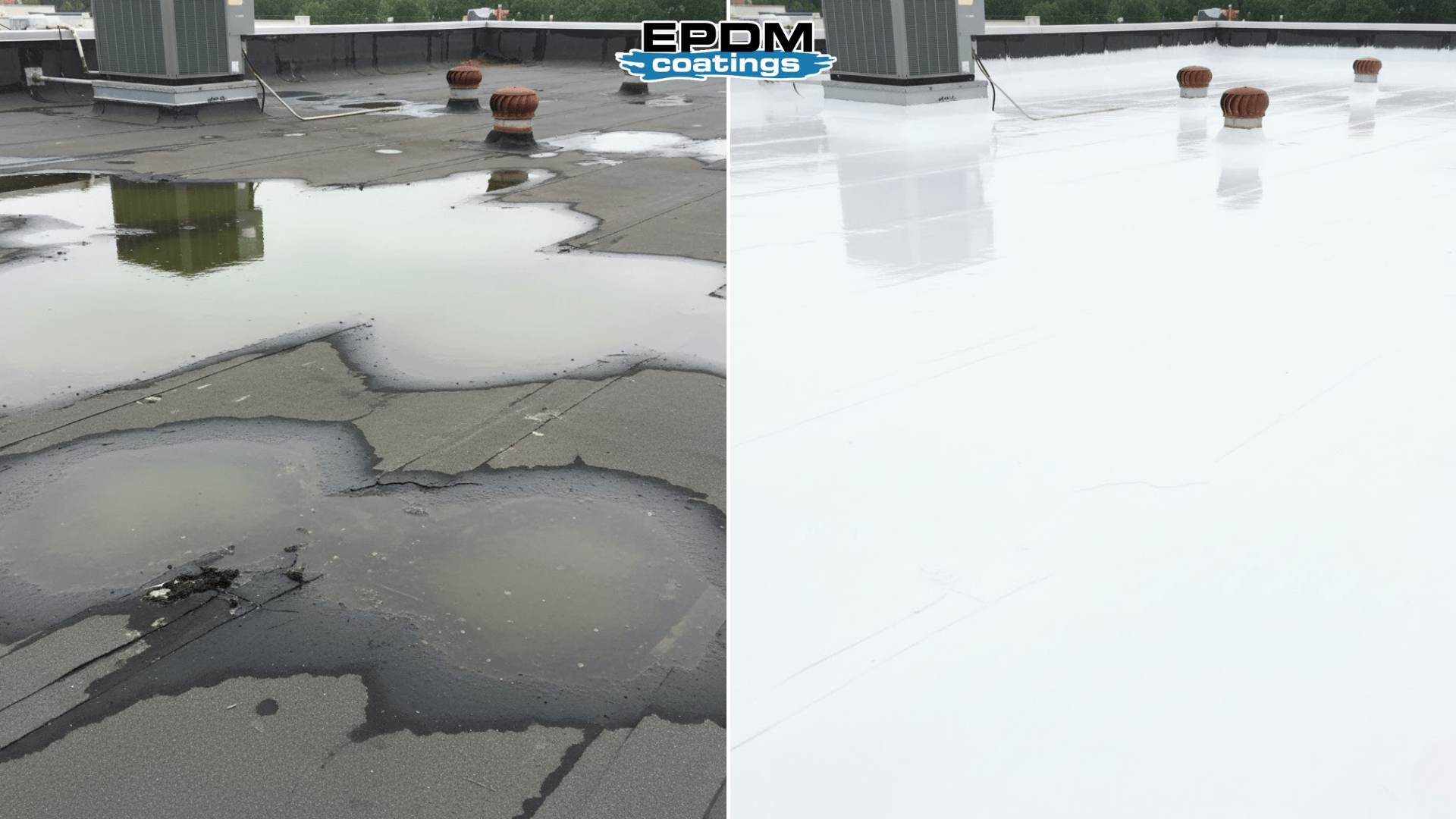
When the material shrinks, the tension pulls at the seams. Since seams are inherently the weakest point of any flat roof, they eventually separate. On top of that, as buildings settle and roofs age, they develop slight depressions and low spots. Rainwater collects in these spots, creating what the industry calls “ponding water.” If water sits on your roof for days or weeks without draining, it will eventually find even the smallest pinhole and force its way into your building.
The Trap of Cheap Acrylics and Elastomeric
When people first decide to tackle their aging roof, they usually head down to a local big-box hardware store. They walk down the roofing aisle and see buckets of acrylics, urethanes, and standard water-based elastomeric coatings. The price tag looks incredibly appealing, so they buy a few buckets and get to work. Unfortunately, they are setting themselves up for a frustrating, expensive cycle of failure.
Here is the harsh reality about standard water-based acrylics and elastomeric: they are essentially just thick paint. They sit on top of your existing roof without ever truly bonding to it. Because they are water-based, they are highly susceptible to the elements. Remember those low spots with ponding water? Traditional elastomeric coatings cannot handle standing water. They absorb it, swell up, blister, and peel right off within a year or two. In controlled accelerated aging tests, these standard acrylics only last about a quarter of the time of premium solutions – meaning you will be back up on the roof fixing it again in 3 to 5 years.
Furthermore, these traditional systems are incredibly labor-intensive. They almost always require you to buy and apply a dedicated primer to ensure the base material sticks. Then, you have to apply two or even three separate coats to achieve the necessary thickness. Not only does this triple your labor and material costs, but it also adds unnecessary weight to your building’s structural integrity.
The Ultimate Solution: The Chemistry of Liquid Butyl Rubber
If you want a genuine, permanent solution that breaks the endless cycle of patching and repainting, you need to move away from water-based paints and look toward advanced, solvent-based chemistry. This brings us to the absolute gold standard of flat roof restoration: liquid butyl rubber.
With a 25-year history of success, this proprietary product has been the secret weapon of major corporations, government facilities, and savvy DIYers across the United States. But what makes it so vastly superior to everything else? It all comes down to the science of how it dries.
When you apply this specialized solvent-based rubber, it does not just dry on top of the surface. As the solvent flashes off, a unique chemical cross-linking process occurs. The liquid membrane chemically fuses with your existing roof. During this drying process, the product actually forces out trapped air that would otherwise cause bubbling. It permanently bonds the two materials, making them literally one single, monolithic membrane. You are not just covering up the old roof; you are structurally integrating a brand-new, impenetrable shield directly into it.
The Advantages of Liquid Butyl
When choosing the best coating for your EPDM roof, you need to look at the physical performance metrics. Here is why liquid butyl stands completely in a league of its own:
- 100% Resistant to Ponding Water: Unlike acrylics that break down under puddles, this product is engineered to withstand continually submerged, standing water 365 days a year. It thrives where other products fail.
- A True One-Coat System: Mil rate (thickness) is everything in roofing. Liquid butyl has a thicker consistency, resulting in a heavy 20-mil film thickness in just one pass. You do not need to buy a primer, and you absolutely do not need multiple coats. One pass provides more protection than three coats of a standard acrylic.
- Extreme Flexibility: Once fully cured, it boasts a massive 500 percent elongation rate and a tensile strength of over 1520 PSI. As your building naturally expands in the sweltering 100-degree heat of summer and contracts in the freezing depths of winter, the coating moves effortlessly with it. It will not snap or crack due to temperature fluctuations.
- Incredible Weather Tolerance: Mother Nature is unpredictable. But with this product, a light rain 2 to 3 hours after application will not ruin your hard work. It waterproofs incredibly quickly. If temperatures drop below 50 degrees, the curing process pauses and will pick up again once it warms up. It easily handles extreme temperature ranges from -40°F to 250°F.
- Built – in Protection: It acts as a powerful rust inhibitor, allowing it to go directly over mild rust on metal fixtures. It is a UV stabilizer that reflects heat away from your building, and it contains built-in mildewcides to ensure mold and other organic growth never take root on your rooftop.
A DIY – Friendly Financial Game Changer
Perhaps the biggest advantage of choosing this advanced formulation is the substantial time and money it saves you during the installation.
Whether you are working with rubber, metal, fiberglass, concrete, TPO, or modified bitumen, the preparation is refreshingly straightforward. Once the surface is clean and fully dry, the product is ready to go, with the catalyst already in the can. Mix it thoroughly using an electric drill mixer.
From there, it is a true do-it-yourself project. For most roofs under 5,000 square feet, all you need is a heavy-duty squeegee and a standard 3/8-inch nap roller. A single gallon covers an impressive 50 square feet. As you spread it out, the product self-levels, and you will literally watch the roller marks disappear. When you finish, every single vulnerable seam, fastener, and transition on your entire roof is completely encapsulated inside the new rubber membrane. You will never have to worry about yearly seam inspections again.
Stop the Cycle of Temporary Fixes
If you are tired of chasing unpredictable drips and throwing your maintenance budget away on temporary elastomeric fixes that peel off every three years, it is time to upgrade your strategy.
By choosing a high-quality, solvent-based butyl rubber solution, you are actively extending the lifespan of your current roof by an additional 18 to 20 years. You bypass the massive labor costs of professional contractors, avoid the environmental waste of tearing off old insulation, and gain the ultimate peace of mind knowing your building is protected by an ASTM-certified product with an undisputed 25-year history of success. Do not let another heavy storm dictate your stress levels. Prep your surface, roll out a single coat of the industry’s best material, and enjoy decades of leak-free reliability. epdm coating contact number: 888-341-2459.